

 See My Latest Article on HelloNation
How can families build math learning into ordinary routines?
Young children learn early math through repeated, hands-on experiences. Counting socks, comparing the size of puddles, sorting buttons, or noticing patterns on a walk can help children develop mathematical thinking without turning home life into a formal lesson.
For families in Allentown, PA, everyday routines offer many opportunities to explore numbers, shapes, measurement, patterns, and problem-solving. The most useful activities are simple, conversational, and connected to what children already notice.
What math skills should young children develop?
Early math includes much more than recognizing numerals. Children gradually learn to:
- Count objects accurately
- Understand that the last number counted tells “how many”
- Compare quantities, sizes, lengths, and weights
- Recognize shapes and describe their features
- Notice patterns and predict what comes next
- Sort objects by color, shape, size, or use
- Use position words such as under, beside, behind, and between
- Estimate, measure, and solve simple problems
- Describe their thinking using mathematical language
A child may understand quantity before being able to write numbers. A preschooler who says that one plate has “more crackers” is already using an important mathematical idea, even if the child cannot identify the written numerals.
How can math be included during meals and cooking?
Food preparation naturally introduces counting, measurement, comparison, and sequencing. Children can count plates, cups, spoonfuls, or pieces of fruit. They can help determine whether each person has one napkin or whether more utensils are needed.
Cooking also creates opportunities to discuss:
- Full and empty
- More and less
- Heavy and light
- Before and after
- Half, whole, and another half
- Longer and shorter
For example, a child might compare the length of two carrots or decide whether a bowl is large enough to hold a mixture. While preparing a recipe, an adult can ask, “What should we do first?” or “What might happen if we add one more spoonful?”
Exact measurements are not required. The goal is to encourage observation and reasoning. If a recipe calls for adult supervision near heat, sharp tools, or appliances, the child can still participate by counting, sorting, pouring with help, or discussing the steps.
What math can children learn while getting dressed?
Dressing routines support matching, ordering, counting, and spatial awareness. A child can match socks, identify pairs of shoes, or place clothing in an order from undergarments to outer layers.
Adults might ask:
- “Which sleeve is longer?”
- “Do you have the same number of socks as shoes?”
- “Which buttons are above the others?”
- “What comes next after putting on your shirt?”
- “Can you find two items that are the same color?”
Children can also sort clothing by season, size, or type. In a household preparing for changing temperatures, comparing jackets, sweaters, hats, and rain gear can make categories meaningful rather than abstract.
How can outdoor play support early math?
Outdoor spaces provide opportunities to explore shape, distance, balance, quantity, and change. Children can count steps to a doorway, compare the lengths of sticks, or collect leaves and sort them by size or color.
During a walk or time outside, try questions such as:
- “How many steps does it take to reach the gate?”
- “Which puddle looks wider?”
- “Can you find a round shape?”
- “How many windows can you see?”
- “What pattern do you notice on the sidewalk or fence?”
- “Which object is closest to you?”
Seasonal conditions also create useful examples. Snow, rain, ice, fallen leaves, and changing daylight can prompt conversations about melting, volume, temperature, sequence, and time. Children do not need to record formal data to benefit. Predicting, observing, and comparing are early scientific and mathematical practices.
How can families use toys and household objects?
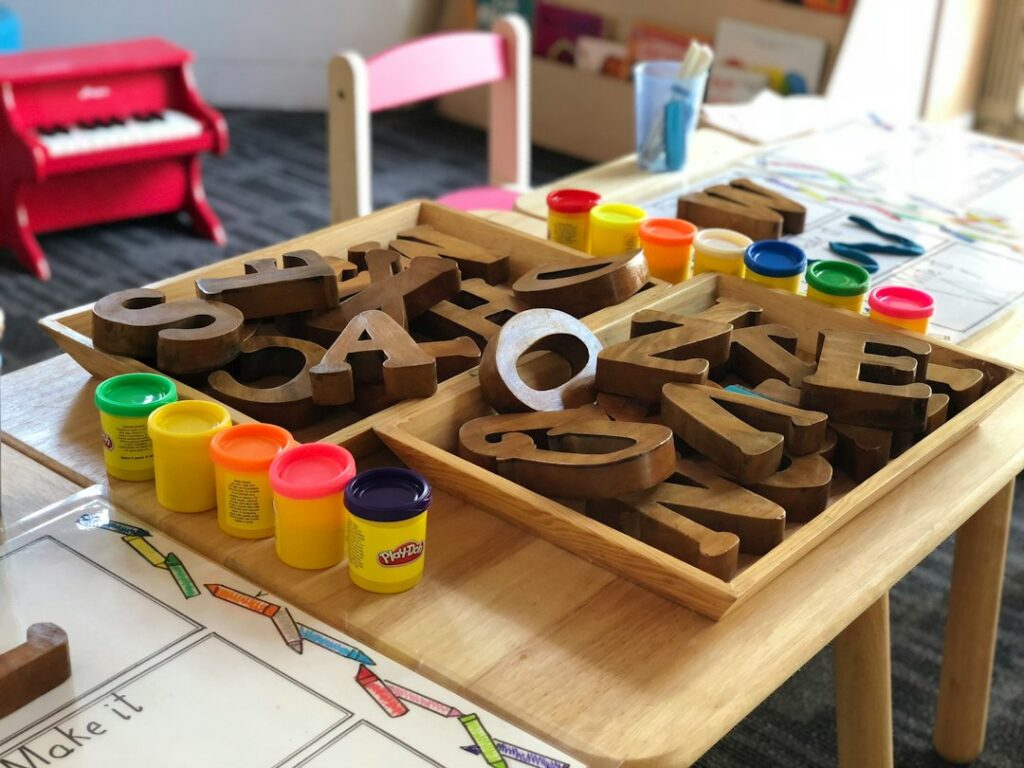
Blocks, containers, puzzles, and small household objects are useful because children can move and reorganize them. Building with blocks encourages children to think about balance, height, width, symmetry, and shape.
Sorting activities can use safe objects such as:
- Lids
- Plastic containers
- Large buttons
- Toy animals
- Socks
- Wooden or foam blocks
- Measuring cups

An adult might say, “Can you make two groups?” and then ask, “How are the groups alike?” or “Can you find another way to sort them?” There may be more than one correct answer. A child could sort objects by color first and then reorganize them by size.
Household objects should be selected with age and safety in mind. Small items can create a choking risk for young children and should only be used with close supervision when appropriate.
How can books and conversations strengthen math understanding?
Picture books often include counting, patterns, shapes, positions, and comparisons. While reading, adults can pause to ask children to find objects, predict what will happen, or explain how characters are arranged.
Instead of asking only, “How many?” try adding questions such as:
- “How do you know?”
- “Which group has fewer?”
- “What might come next?”
- “Where is the bear compared with the chair?”
- “Can you find a shape with three sides?”
- “What changed on this page?”
These questions encourage children to explain their reasoning rather than guess a preferred answer. If a child makes a mistake, the adult can respond with curiosity: “Let’s check by counting again.”
Does screen-free math need special materials?
No. Everyday math can be practiced with ordinary objects and conversations. Special workbooks, apps, or purchased manipulatives are not necessary for a child to develop foundational skills.
A household calendar can support counting days and discussing yesterday, today, and tomorrow. A clock can introduce the idea of routines and elapsed time, even before a child can read it accurately. Laundry, cleanup, grocery organization, and travel through the home can all involve sorting, matching, order, and position.
The adult’s language matters more than the object itself. Words such as more, fewer, equal, tallest, shortest, first, last, near, far, beside, and between help children connect experiences with mathematical ideas.
How much guidance should adults provide?
Adults can support learning by offering a small challenge and allowing time for the child to think. Avoid solving every problem immediately. If a tower falls, ask what the child might change. If two groups appear unequal, invite the child to check by lining up or counting the objects.
Children may use informal strategies that are correct even when they do not resemble adult methods. A child who compares two lines by matching objects one-to-one is demonstrating sound reasoning. Accuracy can develop gradually through practice.
The most effective approach is brief, playful, and responsive. A few minutes of purposeful conversation during a familiar routine can be more meaningful than a long activity that feels disconnected from the child’s interests.
What should families avoid?
Math learning should not become a source of pressure. Children develop at different rates, and early mathematical understanding is broader than memorizing numbers.
Avoid:
- Turning every activity into a quiz
- Correcting every mistake immediately
- Treating fast answers as proof of stronger understanding
- Comparing one child’s progress with another’s
- Expecting written numerals before concepts are understood
- Using only worksheets instead of hands-on experiences
A child may need repeated opportunities to build understanding. Encouragement should focus on effort, observation, and reasoning: “You found a way to make the blocks balance,” or “You checked your answer by counting again.”
How can math become part of the daily rhythm?
Choose routines that already happen regularly. Count steps while moving between rooms, compare containers during cleanup, notice patterns on clothing, or estimate how many toys fit in a basket. Follow the child’s interests and use questions that invite thinking.
The purpose is not to add more tasks to a busy household. It is to help children notice the mathematical ideas already present in cooking, dressing, playing, reading, organizing, and exploring the community around them.